Cleaning soffits and fascias: what it really protects
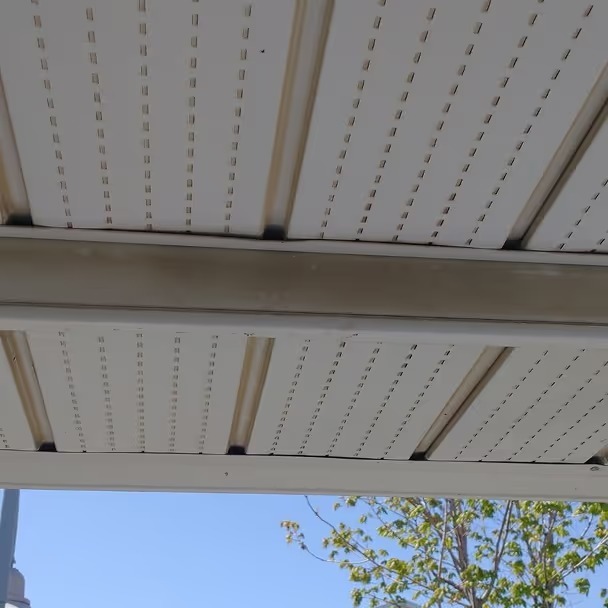
Cleaning soffits and fascia involves removing the dust, debris, and black streaks that accumulate under the roof overhang using a low-pressure wash and a product suitable for pre-painted metal. When done once a year, it protects roof ventilation and restores the original color of the finish.
Key points
- Perforated soffits serve as your roof's air intake: the Code requires a net free ventilation area of at least 1/300 of the insulated ceiling area, and 1/150 for low-slope roofs.
- At least 25% of the openings must be located at the bottom, specifically in the soffits, and 25% at the top.
- An air gap of at least 63 mm is required between the insulation and the roof deck, and 25 mm minimum under the baffles installed at the wall junction.
- The work is performed at low pressure: the metal and vinyl of the roof overhang cannot withstand the direct spray of a high-pressure washer.
- Mold in a residential building is a health risk according to Health Canada, and moisture trapped in a poorly ventilated attic is a common cause.
- An annual inspection of the fascia and gutters costs much less than repairing a rotted roof overhang.
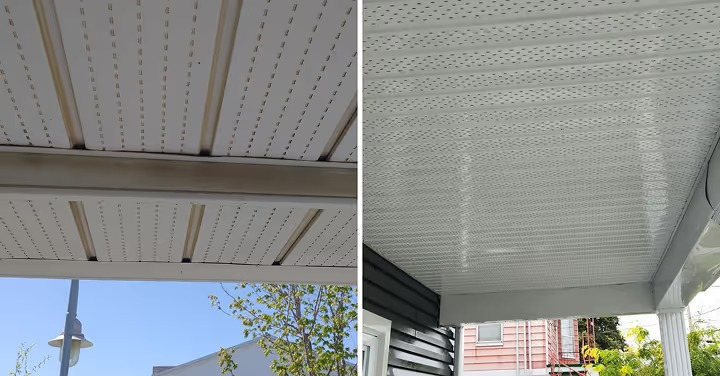
Soffit, fascia, gutter: who does what at the roof edge
The fascia is the vertical board that closes off the ends of the rafters; it is what the gutter is screwed into. The soffit is the horizontal surface that closes the underside of the roof overhang, between the wall and the fascia. Together, they form a continuous border that serves two purposes: sealing the building against the elements and pests, and allowing cold air to circulate through the attic.
This dual function explains why a dirty overhang is more than just an aesthetic issue. The perforations in a panel are fine. Pollen, spider webs, shingle residue, and soot gradually clog them. The result isn't visible from below: airflow decreases, moisture remains in the attic space, and the bill arrives later in the form of mold or prematurely aging shingles.
Why soffits and fascias turn black
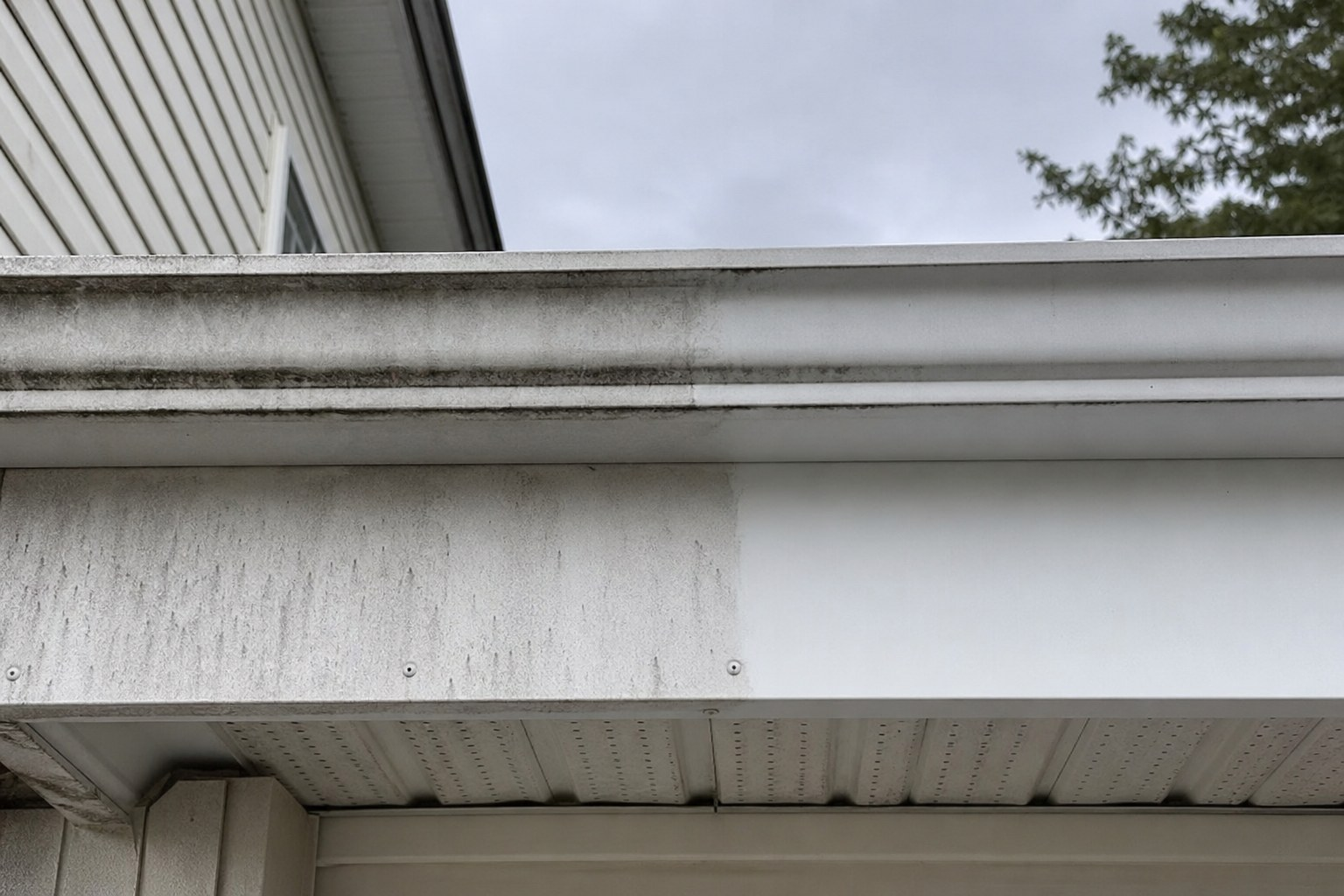
Three causes almost always come up on the South Shore. First, runoff: when a gutter overflows or leaks at a joint, water laden with sediment runs down the fascia, leaving vertical black streaks, the infamous tiger stripes. Next, vegetation: in the shade of a mature maple tree, algae and microorganisms colonize the metal, creating a uniform grayish film. Finally, proximity to roads, which deposits a film of oily particles that everything else clings to.
The distinction matters because it changes the method. A runoff streak comes off with a mild alkaline product and dwell time; a biological film requires a treatment that kills the organism, otherwise it returns within a few months. Scrubbing harder is never the answer: the baked-on finish can be scratched, and a scratched surface gets dirty faster.
The method: clean without force, never the other way around
A professional roof edge service always follows the same order. A preliminary rinse to loosen debris, application of the product from bottom to top to avoid streaks, a few minutes of dwell time, manual brushing of stubborn areas, and then a complete rinse from top to bottom. The pressure used remains low, often under 500 psi at the surface contact, as the action comes from the product, not the water.
The critical point is the angle. A jet aimed upward into the soffit perforations pushes liquid directly into the attic space. This wets the insulation, creating the exact moisture problem that ventilation is meant to prevent. It is the most common mistake made in rushed jobs, and it only becomes visible a season later.
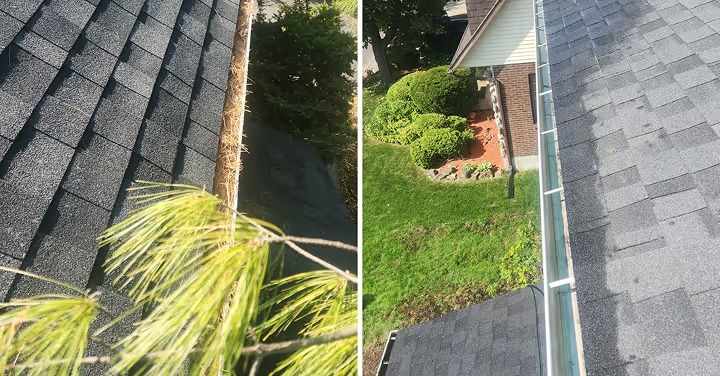
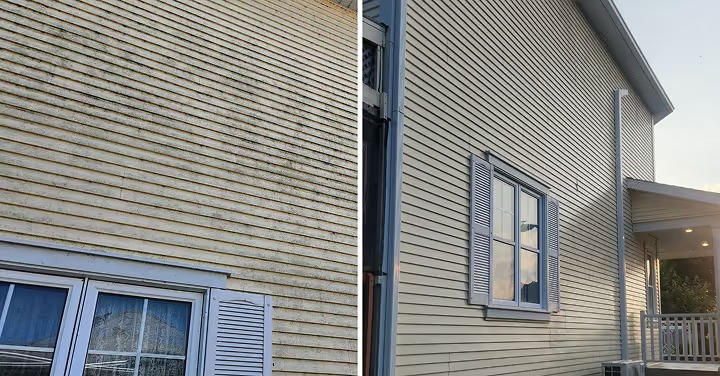
Cleaning the overhang naturally pairs with two other services: facade washing and brightening, since the same technicians are already working at heights, and gutter cleaning and maintenance, which addresses the cause of the runoff rather than just the marks it leaves behind.
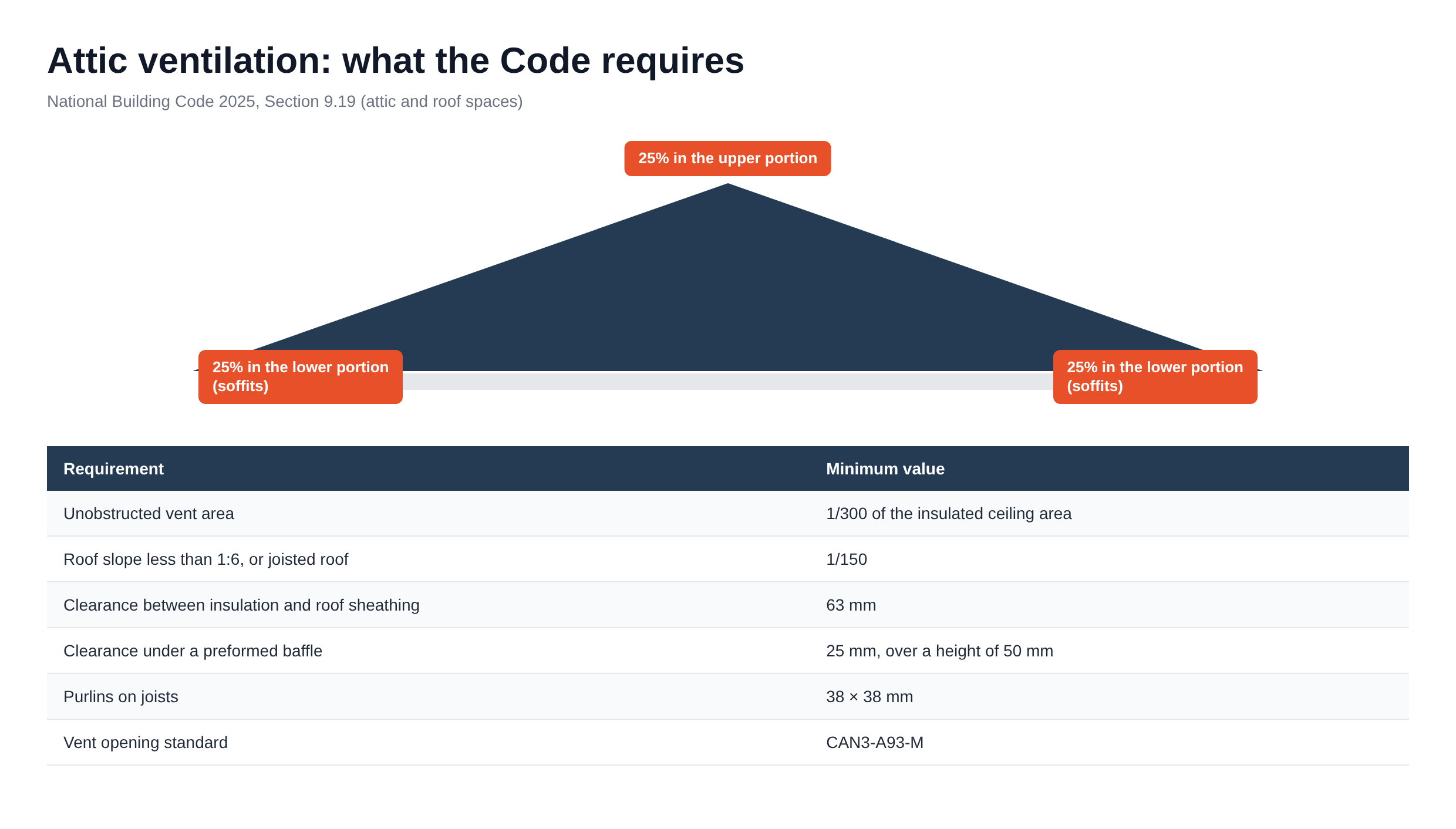
Section 9.19 of the 2025 National Building Code: half of the openings must be located in the lower portion.
What the Code requires for eave vents
The National Building Code, published by the National Research Council Canada and adopted in Quebec by the Régie du bâtiment, sets precise figures for roof space ventilation. The total net free area of the ventilation openings must be at least 1/300 of the ceiling area covered by insulation. This ratio increases to 1/150 when the roof slope is less than 1:6 or when the roof features joists.
The distribution is equally regulated: the openings must be evenly distributed on opposite sides of the building, with at least 25% in the upper portion and 25% in the lower portion. Ridge vents are therefore never sufficient on their own. The Code also requires a clearance of at least 63 mm between the top of the insulation and the underside of the roof sheathing, reduced to a minimum of 25 mm under a preformed baffle which must extend at least 50 mmbeyond the insulation. Where furring strips are necessary, they must be at least 38 × 38 mm. The vents themselves must comply with the CAN3-A93-M standard for building ventilation vents.
The key practical takeaway is this: half of your roof's code-compliant ventilation comes from a perforated strip that no one ever looks at. A panel clogged over 30% of its free area drops the building below the threshold required by the Code, even without any work being done on the roof.
Signs that you need to act now
Some signs are visible from the ground: black streaks on the fascia, a loose or bulging soffit panel, torn mesh near a corner, or wasps or birds entering in the same spot. Others are visible from the inside: frost on the underside of the roof sheathing in January, a damp, earthy smell in the attic, brown rings on the plywood, or compressed, dark insulation along the exterior walls.
These latter signs indicate established moisture. The Institut national de santé publique du Québec reminds us that residential mold grows wherever water stagnates for long periods, and Health Canada considers its presence a health risk to occupants, regardless of the species involved. Cleaning does not fix mold that has already taken hold, but it is the first step in preventing the cycle from starting over.
How often, and at what time of year
A suburban home without mature trees only needs cleaning every two years. Under tree cover, along a busy road, or after roofing work, the schedule becomes annual. The best time is autumn, once the leaves have fallen: the work can then be combined with gutter cleaning, so the building heads into winter with clear openings, which limits the formation of ice dams at the eaves.
Spring is the second best time, especially for north-facing surfaces where algae have been active all winter. Avoid heatwaves: a product that dries before rinsing will leave marks on the finish.
DIY or hire a professional
This is one of the few exterior maintenance tasks where the math clearly favors hiring a professional, for a simple reason: everything happens between 10 and 25 feet off the ground, on a ladder leaning against a gutter that isn't designed to support lateral weight. Falls from heights remain one of the leading causes of serious accidents in residential work.
Then there is the equipment: a telescopic pole fed with softened water, products formulated for pre-painted metal, and the experience to know the right contact time. A well-equipped homeowner can manage a bungalow; on a two-story house with angled downspouts, the risk-to-reward ratio just isn't there. The page gutters, downspouts, and building drainage details what is handled during a visit, and our article on house facade washing explains the same logic applied to siding.
When cleaning reveals a needed repair
A maintenance visit also serves as a health check for the building. Once the surface is clean, damage becomes visible: cracked caulking at a wall joint, brittle vinyl panels, a loose mounting screw, or a misaligned downspout section. These issues are brought to the owner's attention with photos rather than remaining hidden under dirt.
The next steps depend on the scale of the issue. Redoing caulking and replacing two fasteners are routine maintenance. A water-logged board, insulation compressed by a leak, or an entire warped section requires repair, or sometimes a full panel replacement. Our services cover surface cleaning and protection; for carpentry and new installations, we refer you to a licensed contractor. The advice that applies to every project remains the same: identify the problem while it only costs a few minutes of labor, not a season's worth of damage. Contact us for a free quote if a visual inspection leaves you with any doubts about the condition of your property.
Frequently asked questions about soffit and fascia cleaning
Discreet maintenance that protects your roof
Soffits and fascias are the most overlooked parts of a building, yet they are among the most useful. Keeping them clean is inexpensive, can be scheduled at the same time as your gutters, and preserves both the appearance of your siding and the airflow required by the Building Code. To have the condition of

Complete refurbishment of pavers and joints
Deep cleaning, polymer sand removal, mechanical compaction and lasting stabilization.
Learn more about this service
Passionate about outdoor maintenance and attention to detail, she shares practical tips and effective methods for keeping your surfaces clean, durable, and well-maintained.
Are you seeing a similar situation?
Get a detailed evaluation adapted to the real configuration of your property.