Blackened or Greenish Pavers: Why They Get That Way and How to Clean Them

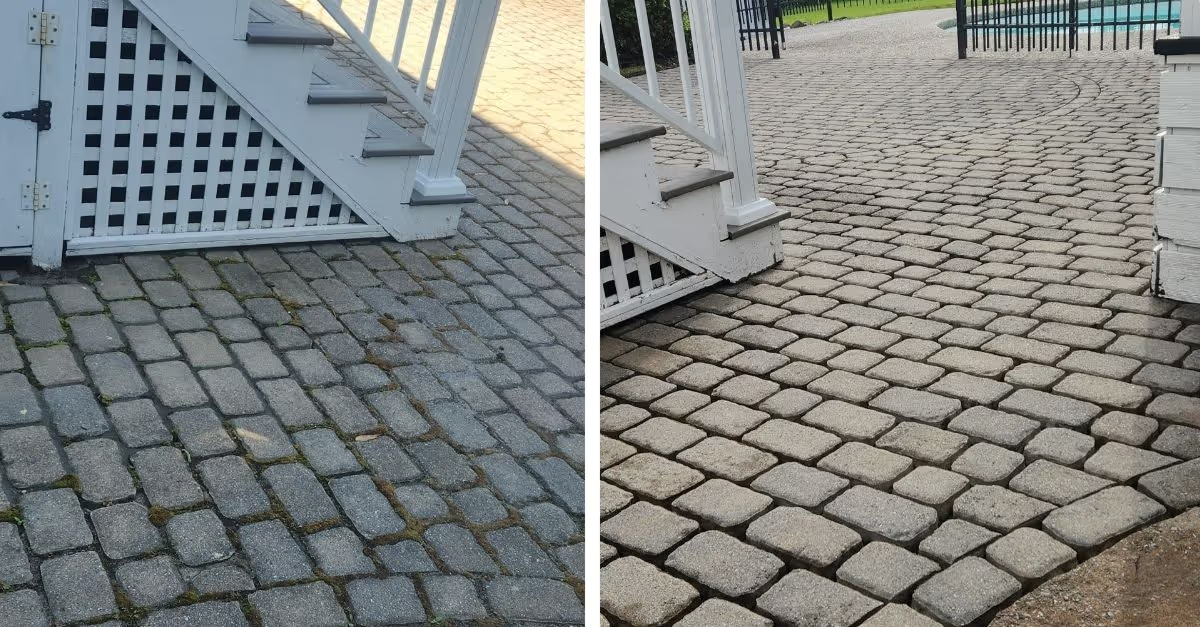
You look at your driveway or patio and the pavers have changed color: black spots, greenish tints, ingrained deposits. Rest assured, it's not a matter of material quality or the age of the installation. It's a common phenomenon that affects most paved areas after a few seasons of exposure to the elements. And in most cases, it can be resolved.
Key takeaways
- Blackened or greenish pavers are caused by microorganisms such as mold, algae, and lichen, not by the degradation of the paver itself.
- Stagnant moisture and lack of sunlight are the main factors that promote their growth.
- Deteriorated joints worsen the problem by retaining even more water on the surface.
- A thorough cleaning can revive the appearance of pavers and restore their original color.
- Acting early prevents organic deposits from becoming more ingrained and weakening the materials in the long term.
Why do pavers change color over time?
The short answer: moisture. The outdoor pavers absorb rain, undergo freeze-thaw cycles, and spend entire seasons in humid conditions, particularly in Quebec. On a porous, poorly sunlit surface, this is enough for microorganisms to settle in : mold, algae, lichen.
These organisms start with slight, almost invisible discolorations. Then they spread, embed themselves, and eventually stain the entire surface gray, black, or green depending on the type of deposit.
CNESST reminds us: mold is found outdoors as much as indoors and proliferates as soon as it finds a source of excessive moisture. On pavers, this source is often water stagnating in poorly sealed joints or on a surface that dries too slowly.

What types of deposits cause these discolorations?
Each type leaves a different mark. Here's how to recognize them:
The most affected areas are those that receive little direct light or that dry slowly after rain : pool surrounds, pathways under trees, north-facing patios.
Do these deposits damage pavers?
Yes, over the long term. Lichens produce organic acids which penetrate into the pores of the concrete and can alter the material's surface. They also retain moisture, which accelerates the degradation of the surrounding joints.
A blackened paver isn't necessarily compromised deep down. But if left unmaintained for several seasons, it can become slippery, lose its uniformity, and eventually require a more extensive intervention than a simple cleaning.
The role of joints in the problem
Well-maintained joints go a long way in limiting water accumulation on the surface of a paved area. When polymeric sand degrades, becoming crumbly or cracked, water infiltrates more between the pavers instead of draining away.
Degraded joints retain moisture, moisture promotes organic deposits, and these deposits accelerate joint wear. Cleaning the surface without addressing the joints, is treating the symptom without tackling the root cause. The stains will return.
What should you do if your pavers are blackened or greenish?
It all depends on what you observe on your surface:
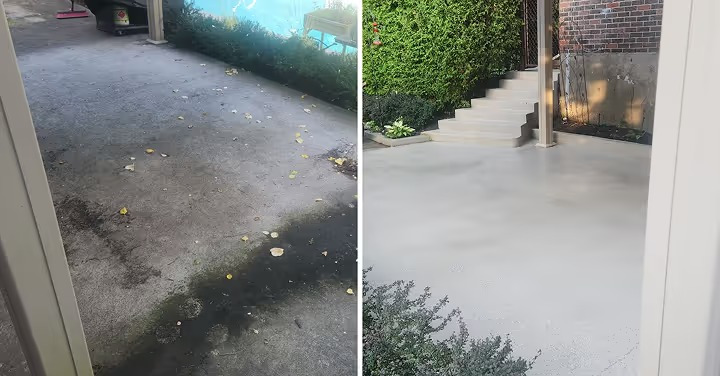
Recent, superficial discolorations: a targeted cleaning may be enough. Have the surface assessed to confirm that the joints are still in good condition.
Stubborn stains and deteriorated joints: a full restoration (deep cleaning combined with polymeric sand replacement) addresses both issues simultaneously and offers a durable outcome.
In both cases, avoid: an excessive pressure without prior assessment. If not properly calibrated, it can remove the remaining polymeric sand from the joints and further weaken the surface.
Best practices to prevent the return of deposits
Trimming vegetation nearby improves sun exposure and air circulation, two factors that help the surface dry faster after rain. Each spring, check the condition of the joints : well-filled joints limit water stagnation between pavers. In autumn, clear fallen leaves before they decompose and leave ingrained organic deposits. And generally, periodic professional maintenance allows for early intervention, before deposits become permanently established.
Your landscaping can regain its original appearance
Blackened or greenish pavers are visually discouraging, especially when you've invested in meticulous landscaping. But these discolorations are usually not permanent. A tailored professional cleaning, combined with replacing the polymeric sand if the joints require it, is sufficient in the vast majority of cases to restore a clean and uniform surface.
The idea is to intervene at the right time, not in an emergency.
Would you like an assessment of your pavers' condition?
If you have doubts about the origin of stains or the best approach for your landscaping, the team at Nettoyage Danfour can assess your situation and guide you toward the appropriate solution.
Contact us for a free assessment offered on the South Shore and in Montreal.
Frequently Asked Questions

Complete refurbishment of pavers and joints
Deep cleaning, polymer sand removal, mechanical compaction and lasting stabilization.
Learn more about this service
Are you seeing a similar situation?
Get a detailed evaluation adapted to the real configuration of your property.